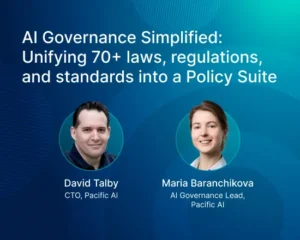
Organizations that develop or deploy Generative AI solutions in healthcare are subject to more than 70 national and state laws, regulatory rules, and industry standards. Once an organization establishes an AI Governance framework, its policies will include dozens of controls that must be implemented for each AI project. This session describes a subset of these controls that can be automated with current tools:
- Automated execution of medical LLM benchmarks during system testing and when monitoring in production, including coverage of medical ethics, medical errors, fairness and equity, safety and reliability – using Pacific AI
- Automating generation and executing of LLM test suites for custom solutions, including testing for robustness, bias, fairness, representation, and accuracy – using LangTest
- Automated generation of model cards, complying with transparency laws and including explained benchmark results – based on the CHAI draft model card standard.
This approach supports broader generative ai governance efforts by promoting accountability, reproducibility, and compliance in the deployment of AI models.
FAQ
What does “automated AI governance” mean for healthcare generative AI systems?
It means deploying tools and policies that automatically track AI usage, evaluate outputs, detect risks like privacy breaches or hallucinations, and enforce human-in-the-loop review to maintain trust and compliance.
How can hospitals monitor generative AI performance in real time?
Real-time dashboards can track metrics like accuracy, sensitivity, and hallucination rate. Alerts get triggered when performance drops or outputs deviate from expectations.
What role does human oversight play in automated governance?
While automation streamlines review via triage, human experts still validate high-risk cases, refine policies, address false positives, and ensure accountability.
What are typical challenges in automating governance for clinical generative AI?
Common challenges include integrating with legacy EHR systems, defining thresholds for alerts, handling diverse data formats, and securing computing infrastructure.
How can organizations start implementing automated governance for generative AI?
Begin with a small pilot in a defined clinical workflow, use modular monitoring tools, train staff on governance protocols, and iterate using feedback loops and performance data.