



Governor: Your AI Control Tower
Automate system and vendor risk assessment, model card generation, risk-level classification, and policy management across every AI system in your organization. Replace weeks of manual documentation with hours of human review on AI-drafted analyses, and consistently evaluate every project against every policy.

Pacific AI helped us implement a governance-first approach – with design assurance, proactive safety, and automation baked into our foundation.


Governance automation, not governance theater
Most AI governance platforms are document-management and workflow tools. They give your team forms, templates, and reminders, then ask the team to do the actual risk analysis, vendor review, and model-card authoring by hand. That does not scale when an enterprise has hundreds of AI systems in flight and a compliance team of 3 to 12 people.
Governor does the analysis itself. It reads project documentation and generates draft model cards. It analyzes vendor SOC 2s, AI disclosures, and data-handling addenda and produces risk scores with the justification spelled out. It proposes risk levels and remediation controls for every AI project on the register.
Your team reviews, adjusts and approves (which is what every regulation requires anyway). But they are reviewing high-quality first drafts, not staring at blank templates. And Governor checks every project against every applicable policy in the Policy Suite the same way every time. Consistently. That coverage is impossible to deliver by hand across hundreds of AI projects.
The realistic alternative is to use AI to govern AI, so that evidence-based evaluation at each stage of each project becomes the default rather than the exception

Helping AI governance committees succeed
The Expertise Gap in Project Teams
A clinician running a revenue-cycle project is not an expert in the hundreds of laws and standards governing AI. Producing a quality risk assessment requires understanding Section 1557, HTI-1, and the FAVES principles CHAI and HHS now expect. Committees end up correcting basic misunderstandings instead of debating strategy.
Knowledge Dilution on the Committee
Committee members are part-time volunteers. Ninety minutes every other week is not enough to stay current on FAVES methodology, NIST AI RMF controls, or the pace of state legislation. Conversation drifts toward business value and ROI, away from the technical frameworks that define defensible governance.
The Scaling Problem
A 2024 Scottsdale Institute survey found large healthcare systems were evaluating more than 225 AI solutions to select roughly 40 for production. A central committee cannot meaningfully review 200-plus projects a year. The result is shadow AI: teams routing around the committee or framing AI projects as standard software updates.
Here’s what Governor does
Every AI System, Version and Owner in One Registry
Register each AI system with its name, version, description and keywords. The registry becomes the controlled inventory of what your organization runs, and which version is active.
Everything that follows (documents, impacts, risks, approvals) attaches to the system’s record, so its full governance history stays in one place.
Your Architecture, Understood From the Documents You Already Have
Upload architecture, data-flow, requirements, release and QA documents, with every version kept. Governor reads them and drafts a structured view of how the system is built, what data it uses and how it operates.
Where the documentation falls short, Governor lists the open questions, so your team fills the gaps instead of rewriting what already exists.
Impact Assessments Drafted From Expert Perspectives
Choose the expert roles to reason from, and Governor proposes the positive and negative impacts on patients, clinicians and your organization, grouped into impact categories.
Your team edits, adds or removes impacts before anything moves on. The assessment bridges the technical architecture and the risks that follow.
Risks Scored, Mitigated and Backed by Evidence
Impacts become candidate risks, organized by AI principle and scored by severity and likelihood into a risk level.
Each risk carries technical and procedural controls, with evidence attached to show they are actually in place, not just planned.
Every Assessment Reviewed, Decided and on Record
Submit an assessment and it lands in the compliance officer’s review queue, with a summary and reports ready. Decisions and the tasks for the next stage are recorded with it.
Approval sets the lifecycle stage and next checkpoint. Provenance and full history show who decided what, and changes to the system trigger reassessment automatically.
Policies That Define What Every Assessment Measures
The Policy Center holds built-in and organization policies, each with its versions and their status.
New versions go through review and approval, and the approved, active version is what every AI system is assessed against.
Model Cards Built From Your Documentation and Test Results
Governor assembles the model card from the system’s documentation and its Gatekeeper test results: basic information, usage and direction, warnings, trust ingredients and key metrics.
Edit any section, export it as a PDF, publish it to the CHAI Model Registry or save it to Documents, and compare models and versions side by side.
Vendor Risk Scored From the Vendor’s Own Evidence
Keep every vendor in one registry, with contracts, BAAs, SOC 2 reports and security policies attached to its profile. Governor drafts the answers to each risk assessment from those documents.
Your team confirms or changes each answer, and analytics show how the vendor scores across cybersecurity, data governance, compliance and more.
Policy to testing to production in one platform
Model Card Metrics Come From Real Test Runs
Governor’s Metrics section pulls automatically from the latest Gatekeeper run (accuracy, fairness, robustness, regulatory readiness). Every number ties to a specific run ID and can be reproduced.
Risk Register Controls Connect to Live Test & Monitor Results
Every control wires to its Gatekeeper test suite and Guardian monitor, with the live status shown in the register: green, yellow, red.
Vendor Risk Scores Attach to Every Project That Uses the Vendor
A vendor’s score ties to every project on the register that uses them. When the vendor ships an update, Governor shows exactly which projects need re-testing and which monitors to re-baseline.
Real-world example: The 2025 – 2026 AI-Impersonation Laws
When five state laws prohibiting AI from impersonating licensed clinicians took effect, Pacific AI customers did not write a policy or hire counsel.
The Policy Suite refresh added the new policies. Governor flagged every patient-facing AI system, Gatekeeper and Guardian picked up the new tests automatically. All within days and without manual effort.
Why Governor instead of a generic GRC platform
Generic GRCStores documents, routes approvals, sends reminders. The risk analysis, vendor review, and model-card authoring stay manual.
Governor Reads project documentation. Generates draft model cards. Analyzes vendor AI policies . Produces risk scores with the justification spelled out.
Generic GRCAnnual policy review. Quarterly audit. Risk register refreshed when something breaks.
Governor Every project re-evaluated when policies refresh. Every vendor re-scored when their term of use changes. Policy Suite updates flow into the registry automatically.
Generic GRCSOX, HIPAA, GDPR. Generic frameworks that don’t reach AI-specific risks in clinical contexts.
Governor CHAI, FUTURE-AI, TEHAI, MEDIC, CONSORT-AI baked into every workflow.
A complete AI governance platform
The Compliance Officer
Manages the compliance program across the organization’s entire AI portfolio.
frameworks tracked,
refreshed quarterly
The Risk Manager
Identifies, assesses, and mitigates risks across the AI lifecycle with real-time monitoring.
pre-configured,
auto-scored
The AI Developer
Builds, tests, and deploys AI models with built-in governance guardrails at every stage.
with automated
governance checks
The Vendor Manager
Oversees third-party AI vendors with continuous due diligence and contract compliance.
with automated
due diligence
The Policy Manager
Creates, distributes, and enforces AI policies that stay current with evolving regulations.
rate with automated
tracking
Your Risk Assessments Never Leave Your VPC
The risk assessments, vendor analyses, and model cards Governor produces, including the documents that show where your AI deployments are taking legal risk, never leave your VPC. Governor runs inside your AWS or Azure tenant; Pacific AI has no access to its contents.
Learn more about Pacific AI’s single-tenant architecture →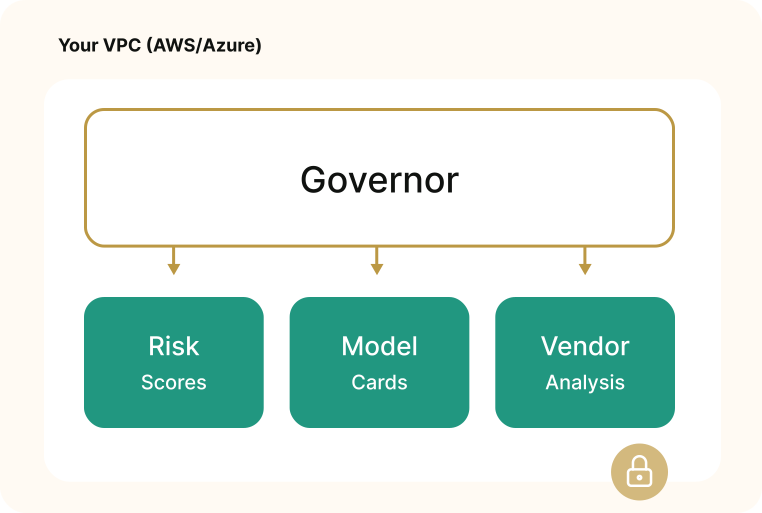
The downstream impact of biased automation in healthcare isn’t academic – it affects real decisions, real care, and real people.


Get Started
With Pacific AI there is no license to buy and no implementation project before you can start.
Deploys in Minutes
CloudFormation or Managed Apps, inside your AWS or Azure tenant.
Platform Core $0 Forever
Unlimited users, systems, policies, tests, audit trails. Pay only per AI credit.
Agent-Ready
MCP-native integration with agentic AI systems out of the box.
Build the full AI governance program
12-Week AI Accelerator
Forward Deployed Experts (12 months)
Private LLM Deployment