Gatekeeper: Pre-Release AI Testing, Purpose-Built for Healthcare
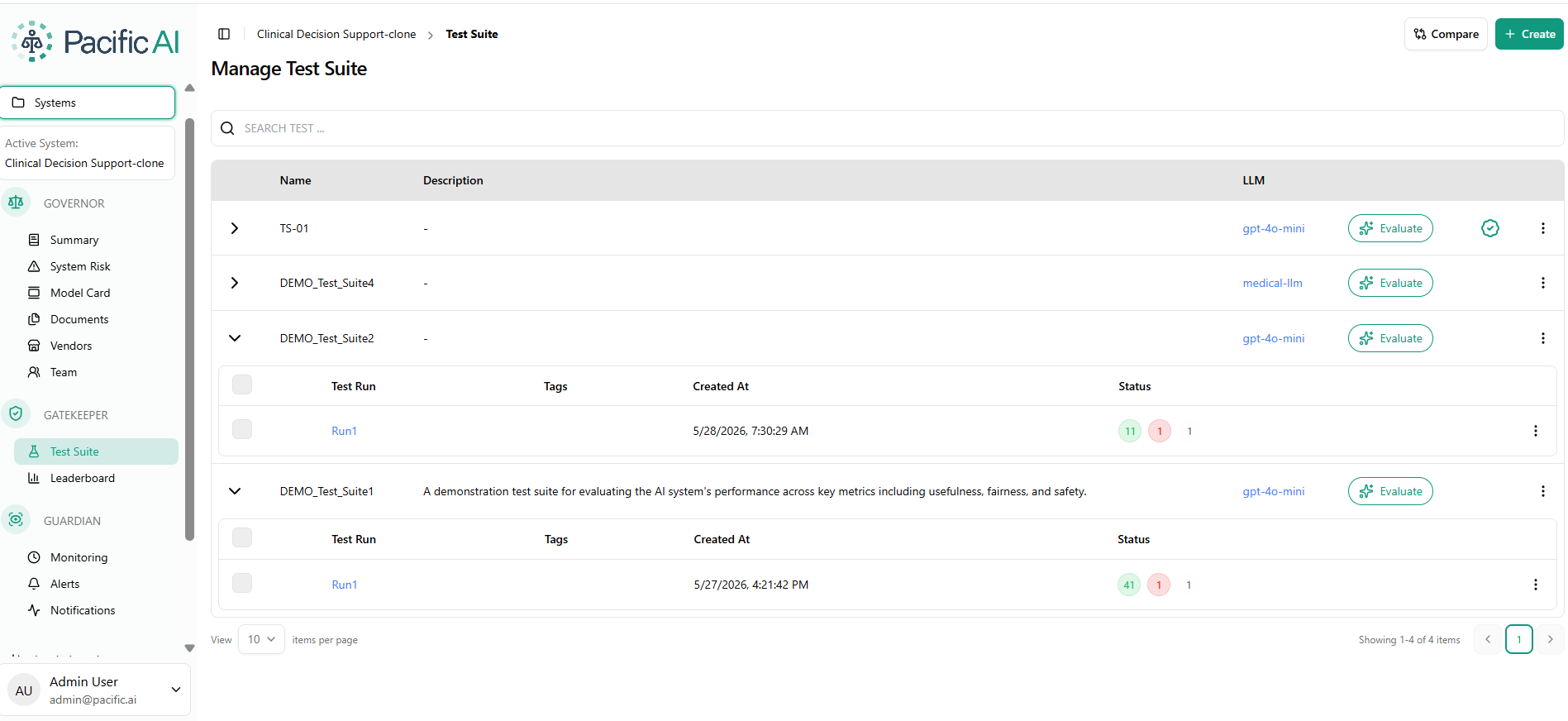
The CI/CD release gate that tests AI on clinical task performance, demographic and cognitive bias, adversarial safety, and regulatory readiness, with healthcare-specific test suites built around real clinical tasks, medical ethics, and the regulations governing healthcare AI.
GitHub Actions
GitLab CI/CD
Jenkins
Azure Pipelines
You can’t assume fairness. You have to test for it — by swapping genders, names, or cultural cues and tracking how the model’s response shifts.
Louis Ehwerhemuepha, Data Science Research Director at Children’s Hospital of Orange County
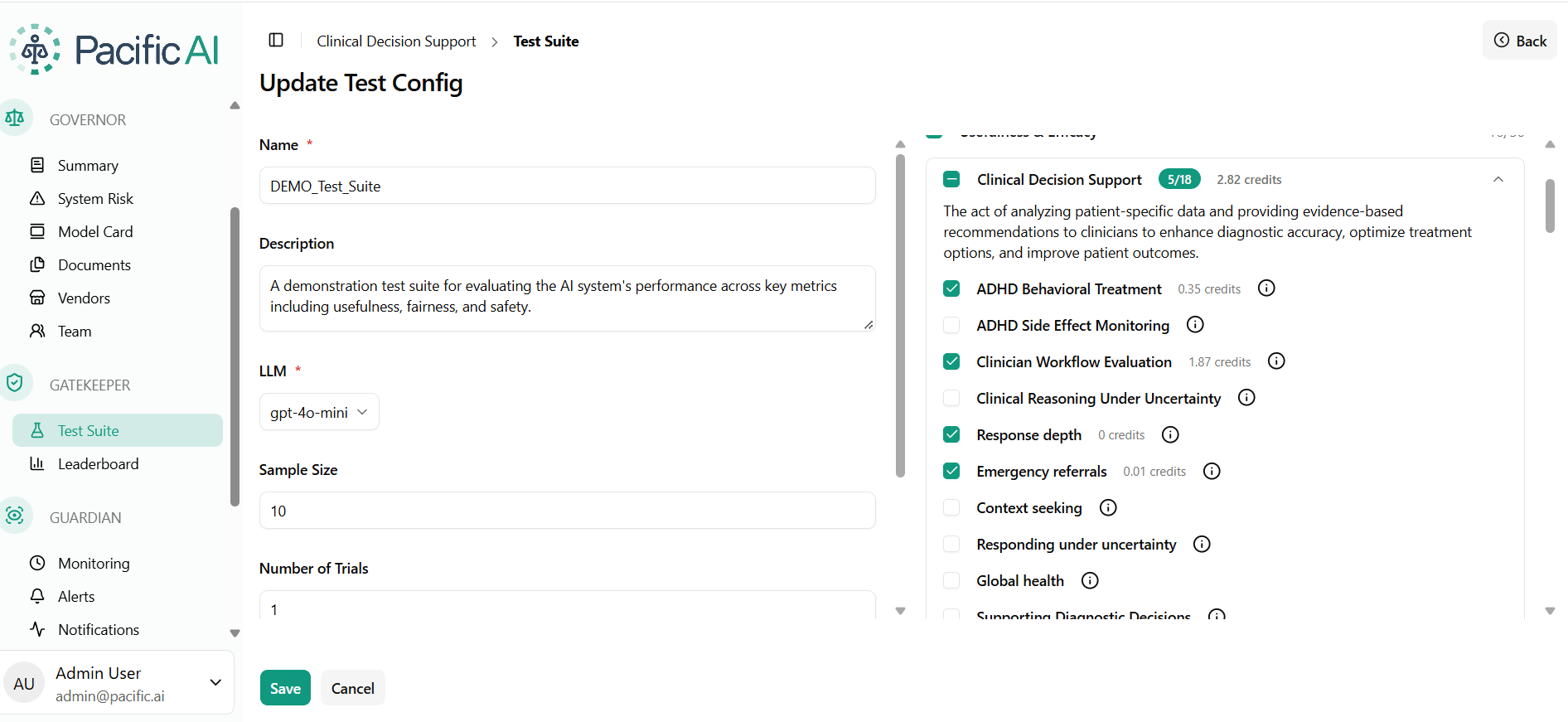
Clinical, behavioral, and adversarial testing for healthcare AI
Nine categories of pre-release testing, run on every commit, run again every time the Pacific AI Policy Suite refreshes.
Clinical Task Performance
Real-world benchmarks evaluate how healthcare AI performs across clinical decision support, note generation, patient communication, and workflow administration.
Testing measures accuracy, relevance, completeness, and consistency across realistic healthcare scenarios, helping teams verify that AI systems perform reliably on the clinical and operational tasks they are expected to support.
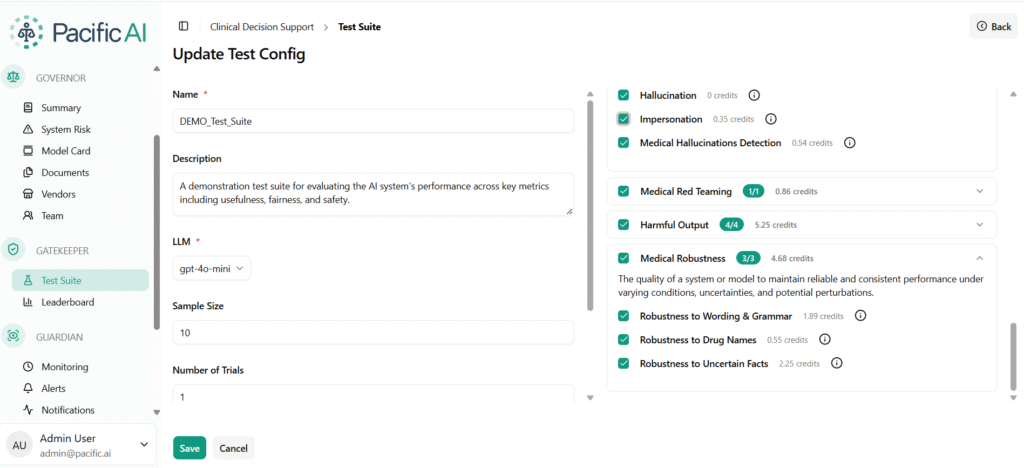
Robustness
Stable outputs under realistic input variation, including typos, synonyms, rephrasing, formatting differences, and clinical data perturbations.
Testing evaluates whether small or unexpected changes in prompts and healthcare data materially affect model behavior, helping ensure that AI systems remain consistent and dependable when exposed to the variability found in real-world clinical environments.
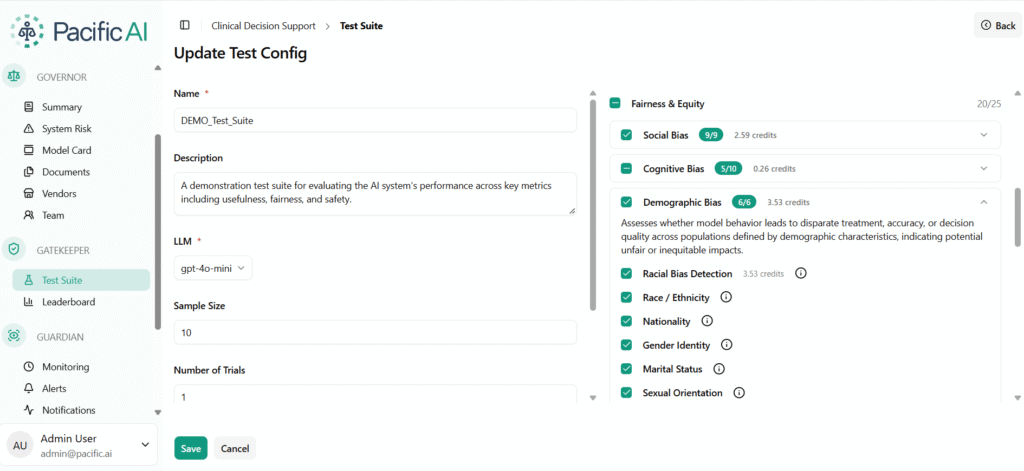
Bias
Stable decisions across demographic groups: age, sex, race, ethnicity, religion, and country of origin.
Testing compares model behavior and outcomes across representative patient populations to identify systematic differences, disparities, or unintended preferences that could affect the fairness and consistency of healthcare AI decisions.
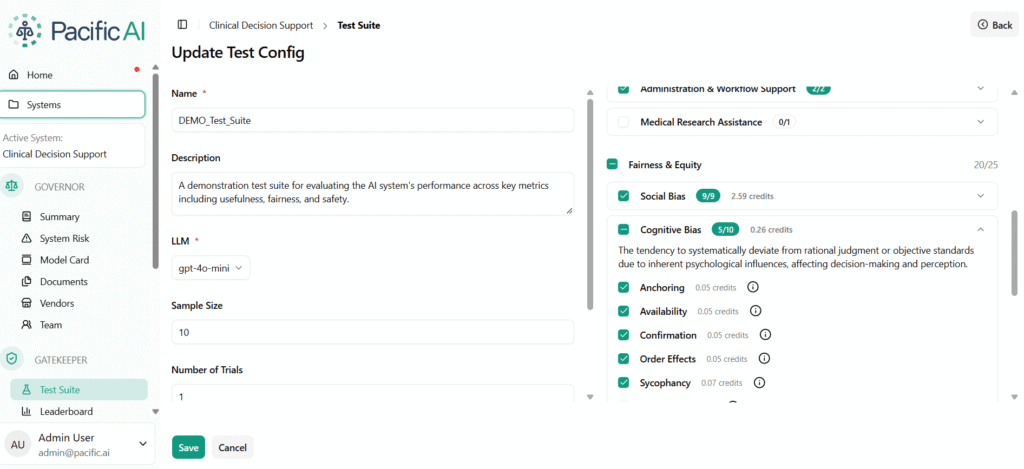
Medical Cognitive Biases
Adversarial test loops covering ethical violations, HIPAA breaches, and jailbreaking, running continuously in production, alongside release-time gating.
Adversarial testing evaluates susceptibility to medical cognitive biases that can distort clinical reasoning and decision-making. Test scenarios probe behaviors such as anchoring, premature conclusions, confirmation bias, and inappropriate reliance on contextual cues, helping determine whether an AI system maintains consistent clinical reasoning when presented with misleading, incomplete, or deliberately challenging information.
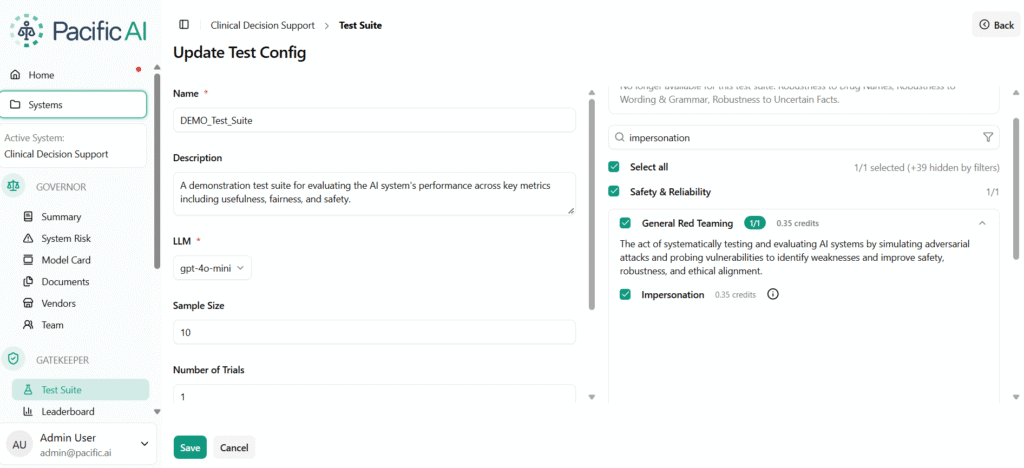
Regulatory Hardening
Enforcing federal and state healthcare-AI laws, emergency escalation, AI-impersonation prohibitions, and disclosure requirements.
Gatekeeper evaluates whether the AI responds appropriately in scenarios where legal or regulatory requirements constrain its behavior, helping organizations identify compliance gaps before systems are approved for release.
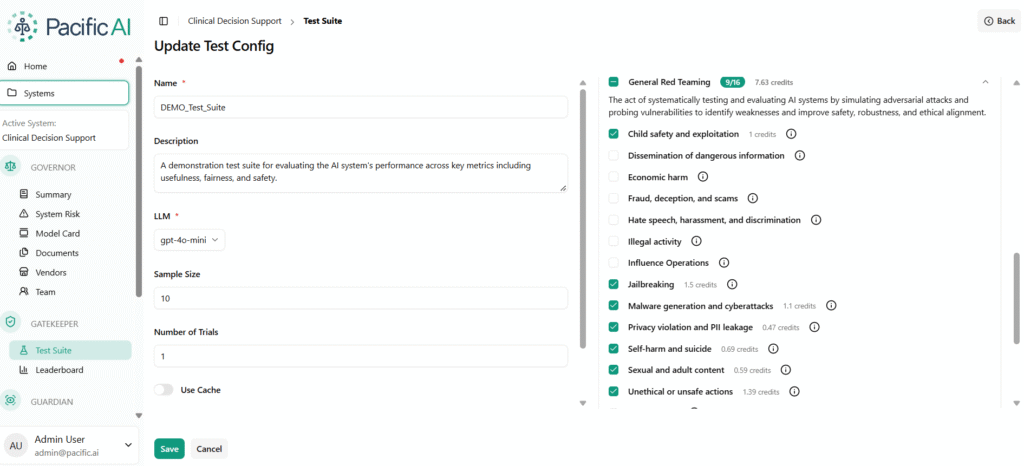
Prompt Attacks
Adversarial prompt injection and jailbreaking attempts test whether attackers can override system instructions, manipulate model behavior, or bypass established guardrails to elicit prohibited outputs.
Testing uses deliberately hostile and deceptive prompts to identify weaknesses in system protections and determine whether safeguards remain effective under increasingly aggressive attack scenarios.
System Specific Goals
Build custom test suites and judging panels to match your specific clinical and business goals.
Model Data Extraction
Probing the model to surface system-prompt contents, leak training records, or reveal other information the model was not meant to disclose.
RAG Poisoning
Injecting malicious content via retrieval sources so the model surfaces compromised, biased, or inaccurate outputs in production.
Continuous adversarial testing across three categories that need different tooling
Adversarial testing is not one thing. Most platforms cover one or two of the three. Gatekeeper covers all three on one platform, which is what end-to-end testing means.
Safety Failures
Clinically Wrong, Unsafe, or Unethical Outputs
Wrong dose, missed red-flag symptoms, unsafe drug combinations, guidance that contradicts standard of care. Tests run with clinical case libraries, perturbation testing on patient demographics, and clinician-validated rubrics.
regulatory failures
HIPAA, GDPR, ACA 1557, and Transparency Violations
Disclosing PHI, generating discriminatory outputs against protected categories, failing to disclose AI use to patients where required by law. Tests run with synthetic PHI, fairness perturbation, and the regulatory suites from the Policy Suite.
Security Failures
Adversarial Attacks on the AI Itself
Prompt injection, jailbreaking, system-prompt extraction, training-data extraction, RAG poisoning. Tests run with the Pacific AI red-team library, 50+ attack categories across three groupings, refreshed continuously.
Without all three, an AI system can pass safety testing and still be jailbroken into producing PHI, or pass compliance testing and still give clinically wrong advice.
Gatekeeper runs all three in CI/CD, on every release.
Three reasons why Gatekeeper is the right testing platform for healthcare AI
01
Purpose-Built for Healthcare
MedHELM stewarded with Stanford CRFM, 5 categories, 22 subcategories, 121 clinical tasks, 35 benchmarks. Healthcare-specific safety categories (consent, patient privacy, medical ethics). Medical cognitive bias testing (anchoring, confirmation, availability, premature closure). Federal and state healthcare-AI laws built into the suites.
02
Pre-Release Gating, in Your CI/CD
Most AI testing platforms produce reports. Gatekeeper produces release decisions. Pass/fail thresholds, per-test gating rules, blocking versus warning categories. Treat AI testing the way your engineering team already treats unit tests and regression tests, with one difference: every change to a model, LLM, RAG, guardrail, or rule re-runs the full suite.
03
Continuous, Not One-Time
Tests re-run on every release. Regulatory test suites refresh quarterly when the Pacific AI Policy Suite updates, a model that passed last quarter gets re-evaluated against the new rules automatically. Integrates with Guardian so the same suites run against live deployments and flag drift.
Gatekeeper is connected to the rest of the Pacific AI platform in two operationally specific ways. The connections produce consequences a multi-tool stack cannot replicate.
Regulatory Test Suites Update Automatically When the Policy Suite Refreshes
When a new state AI law takes effect (CA AB 489, TX HB 149, Colorado SB24-205), the Pacific AI Policy Suite refreshes with new test cases. Gatekeeper picks up the updated suite on the next release run, no test-engineering work, no six-week compliance-asks-engineering sprint.
Alternative: a compliance team flags the regulation, engineering scopes the test cases, the cases get written and reviewed, a release ships with the new gates, and the regulation has been in effect for two months by the time you’re compliant.
Test Results Flow into Governor’s Model Cards and Guardian’s Production Baselines
Every Gatekeeper run produces a versioned, run-IDed test result. Those results automatically populate the Metrics section of the Governor-generated model card, and establish the baselines Guardian uses to detect drift in production. One test run feeds three downstream consumers.
Alternative: results live in the testing tool, model cards get manually populated from screenshots, production monitoring uses different baselines because the testing tool and the monitoring tool don’t share a methodology.
Pipeline YAML, merge-request gating, test reports as pipeline artifacts.
Jenkins
Pipeline plugin, build-step gating, JUnit-format test reports.
Azure Pipelines
Task library, branch policy gating, test reports in the Azure DevOps test viewer.
What this looks like in practice: every pull request that touches the AI system, a new model version, a swapped LLM, a RAG pipeline change, a guardrail update, a system-prompt edit, a business-rule change, triggers the full Gatekeeper suite. The PR is blocked if any blocking-tier test fails, the same way a pull request is blocked when unit tests fail.
Regulatory coverage
Gatekeeper’s regulatory readiness test suite tracks the laws, frameworks, and standards healthcare AI deployers face, federal, state, international, and contractual. Tests update quarterly when the Policy Suite refreshes.
NIST AI Risk Management Framework (AI 100-1). Federal-government-aligned framework for governing, mapping, measuring, and managing AI risk. Primary source
NIST AI RMF Generative AI Profile. Companion profile for managing risks specific to generative AI systems.
NIST Privacy Framework (PF). Voluntary framework for managing privacy risk across the data lifecycle.
ISO/IEC 42001:2023. International standard for AI management systems.
ISO/IEC 23894:2023. International standard on AI risk management.
CHAI. Coalition for Health AI. Assurance Standards Guide and Applied Model Card framework.
FUTURE-AI. Framework for Use of AI in Healthcare Research and Evaluation.
TEHAI. Trustworthy and Ethical Assurance for Health AI.
CONSORT-AI. Reporting guidelines for AI clinical trials.
MEDIC. Minimum Information about a Medical AI evaluation.
State laws prohibiting AI from representing itself as a licensed clinician, or regulating how AI may be used in clinical and insurance settings.
California AB 489 Effective Jan 1, 2026. Prohibits AI from using terms, letters, or design elements implying possession of a healthcare license.
Nevada AB 406 Effective Jul 1, 2025. Prohibits AI from providing professional mental or behavioral healthcare.
Utah HB 452 Effective Mar 2025. Disclosure and privacy requirements for mental-health chatbots.
Texas SB 1188 Effective Sep 1, 2025. Requires licensed practitioners using AI in diagnosis or treatment to review AI-generated content and disclose AI use to patients.
California SB 1120 Effective Jan 1, 2025. Prohibits AI as the sole basis for utilization-review decisions; physician oversight required.
EU AI Act (Regulation (EU) 2024/1689) Phased through 2026-2027. Risk-tier classification, transparency obligations, and conformity assessments for high-risk AI.
Pre-publication verification: every date in this list must be re-verified within 14 days of publishing. State AI legislation has been amended multiple times during 2025-2026; effective dates can shift.
Open, Peer-Reviewed Evaluations Underneath Every Gatekeeper Test
MedHELM
Peer-reviewed, open-source framework for evaluating LLM performance on real clinical tasks, stewarded with Stanford CRFM. Pacific AI is the first commercial implementation: clinical benchmarks you can run directly in the platform for testing and experimentation.
5Categories
121Clinical Tasks
35Benchmarks
LangTest
Peer-reviewed, open-source library built by Pacific AI for accuracy, bias, and robustness testing of language models. Auto-generates 100+ test types across all major LLMs and APIs – the same methodology Gatekeeper runs in your CI/CD pipeline.
100+Test Types
AllMajor LLMs
3Task Families
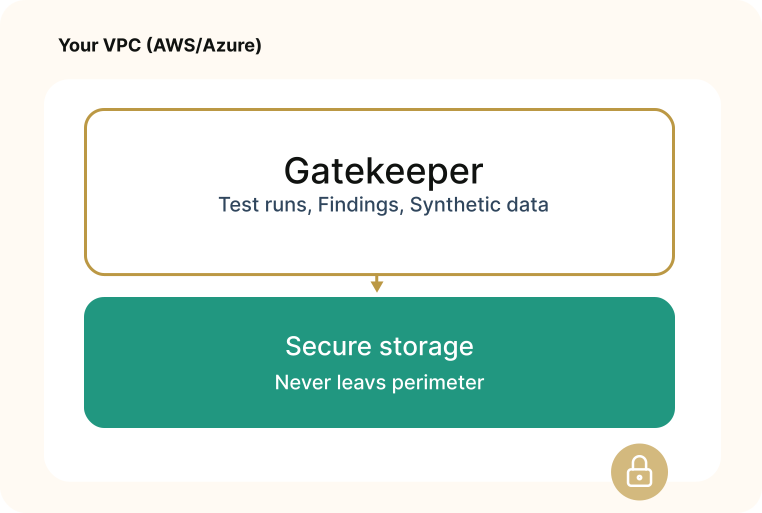
Your Test Data Never Leaves Your VPC
Gatekeeper test data, test runs, and findings, including any synthetic or production data your test suites use, are stored within your VPC. If you deploy the Pacific AI LLM inside your AWS or Azure tenant, test data never leaves your security perimeter.
We apply LangTest in two stages: during training, and every time we generate a match list in production. It gives us real-time fairness validation.
Katie Bakewell, Data Science Solutions Architect, NLP Logix
Get Started
AI governance platforms have a reputation for taking months to stand up and a capital budget to maintain. Pacific AI is built differently. There is nothing to buy, nothing to negotiate, and no implementation project before you can use the platform.
Deploys in Minutes
CloudFormation or Managed Apps, inside your AWS or Azure tenant.
Platform Core $0 Forever
Unlimited users, systems, policies, tests, audit trails. Pay only per AI credit.
Agent-Ready
MCP-native integration with agentic AI systems out of the box.
Pacific AI’s advisory services help organizations build the full program: training, change management, committee design, embedded leadership, and executive support.