


Static AI risk assessments describe systems as they existed months ago. A recent survey found that AI governance teams receive three system submissions for every two governance decisions they can complete, typically leaving one or two reviewers to track model updates and regulatory revisions across multiple deployed AI systems. When policies or architectures change, manual spreadsheet reviews fall behind. Automating continuous risk reassessment and production drift monitoring keeps risk registers, model cards, and audit trails accurate without rebuilding assessments from scratch.
Why static AI assessments fail in production
An enterprise AI risk assessment is approved once based on a specific system architecture and regulatory baseline. After release, external regulations, internal system architecture, and production model behavior change every week. For example, the Pacific AI Policy Suite tracks 600+ global and healthcare-specific laws, regulations, standards, and frameworks across 30+ countries and is updated every quarter. Meanwhile, engineering teams typically update model weights, prompts, data flows, and retrieval pipelines every week.
Generic governance, risk, and compliance (GRC) platforms rely on manual forms and static templates, producing governance theater when underlying models evolve between audits. When a policy updates or an engineering team uploads a new architecture document, static tools require your reviewers to evaluate the entire system from the beginning. For a healthcare organization managing multiple AI systems with a governance team of one or two people, full manual reassessment is unworkable. The backlog grows at a 3-to-2 ratio of AI submissions to governance decisions, leaving approved assessments on file that no longer match the systems running in production.
Pacific AI replaces manual document tracking with governance automation purpose-built for healthcare, connecting end-to-end policy mapping in Governor, pre-release CI/CD gating in Gatekeeper, and post-deployment monitoring in Guardian across multiple governed AI systems.
How Governor patches risk registers on update
Governor is your AI control tower, automating risk registers, policy mapping, vendor risk assessments, and model card authoring. Instead of regenerating an entire Design Assurance Document or risk register when a file changes, Governor diffs the update, evaluates only the affected chapters and risks, and copies prior human decisions forward.
System documentation updates
An engineer or system owner uploads a revised Architecture and Design Document, Data Flow Document, or Product Requirements Document (or pushes a code delta via a CI/CD webhook) for a specific system such as a clinical documentation scribe. Governor calculates the delta and queues a targeted reassessment task for that single system.
Policy library updates
A compliance officer updates an internal control or imports a quarterly update from the AI Policy Suite covering standards such as the NIST AI Risk Management Framework (NIST AI RMF), ISO/IEC 42001:2023, the Joint Commission Responsible Use of AI in Healthcare (RUAIH) certification, or Coalition for Health AI (CHAI) assurance checklists. Governor queues automated reassessment tasks across every deployed AI system subject to that policy.
Copying human decisions forward
Automated reassessment stalls if every minor architectural change forces the AI governance committee to re-approve 50 existing controls. In Governor, previously approved and rejected risk items stay as they were when their underlying architectural and policy inputs remain unchanged. Reviewers evaluate only the newly identified risks or the specific mitigations invalidated by the update.
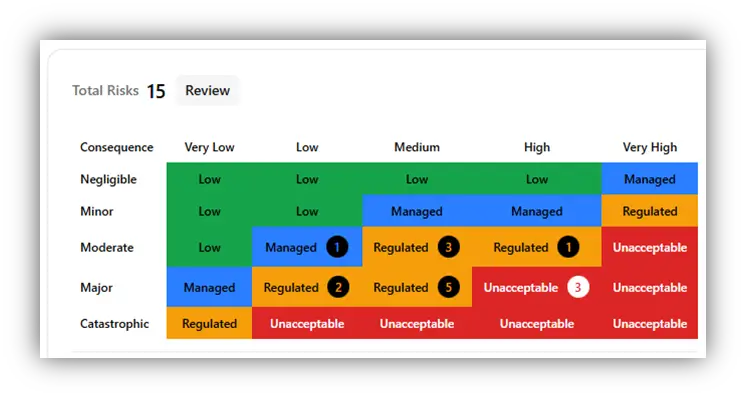
Risk Assessment Matrix as generated by Pacific AI Governor.
How Gatekeeper and Guardian detect production drift
Governance does not stop when a risk assessment is approved. Models change in production, and clinical prompting patterns change over time. Pacific AI connects pre-release testing to post-deployment monitoring by running the same healthcare-specific test suites in Gatekeeper and Guardian, built on LangTest’s 100+ test types and 60+ healthcare-specific test suites across 50+ medical red-teaming categories.
During CI/CD release gating, Gatekeeper evaluates release candidates across clinical bias, clinical reasoning, summarization accuracy, diagnostic documentation, and safety tasks. When a release candidate passes and a reviewer approves it for production, you flag that evaluation run in green as the production baseline.
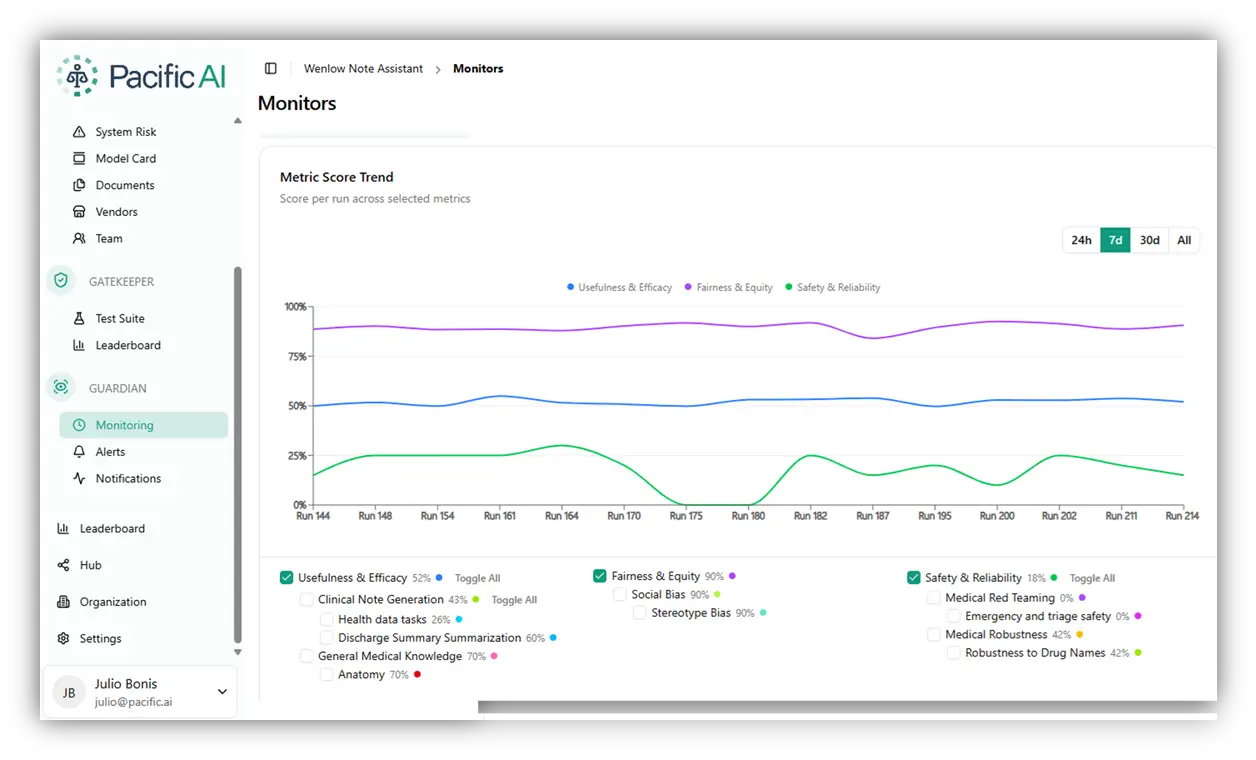
AI Monitoring report as generated by Pacific AI Guardian.
Once the system is in production, Guardian runs those identical test suites on a scheduled cadence (hourly, daily, or weekly) against the production endpoint. You configure custom drift alert rules tied to your baseline metrics:
- Threshold rules trigger an alert if a clinical task score or fairness metric drops below a set boundary, such as an 80% minimum threshold or a defined percentage drop from baseline.
- Consecutive failure filters require a threshold to be crossed a specific number of times, such as 3 consecutive runs, before paging the governance owner to prevent single-run noise.
- Automated escalation actions log a warning, notify the clinical informatics team, or fire an automated webhook to halt the affected version in production.
Three engineering patterns keep automated governance auditable
Using LLMs inside a governance system introduces operational failure modes: duplicate event triggers, model hallucinations in compliance records, and scoring discrepancies between staging and production. When a Chief Compliance Officer or Chief AI Officer defends a risk register to an external auditor, probabilistic LLM outputs cannot write unchecked to the system of record. Pacific AI enforces 3 engineering patterns to maintain audit defensibility.
1. Idempotent runs via atomic database claims
When engineering teams push multiple commits or update several policy mappings in rapid succession, webhook triggers often arrive twice within milliseconds. Checking whether a reassessment workflow is already running and starting the job in two separate steps creates a race condition where duplicate LLM assessments execute at the same time.
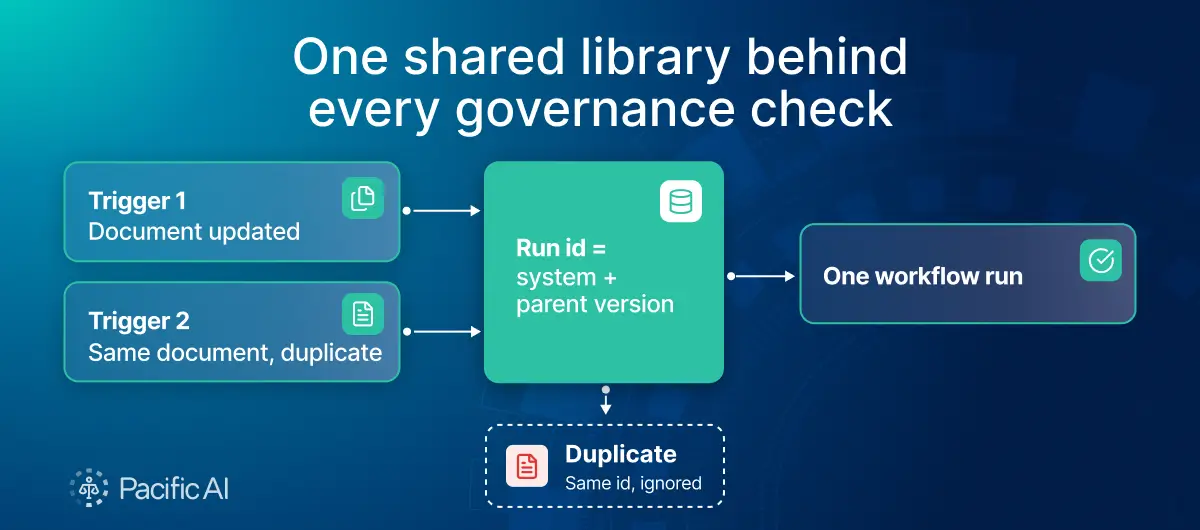
Pacific AI prevents duplicate execution by combining the system ID, a cryptographic hash of the workflow trigger inputs, and the parent version number into a single atomic claim in the database. If two identical triggers arrive against the same parent version, the database grants the claim to the first request and drops the duplicate before any LLM tokens are spent.
2. Separation of LLM judgment and code
LLMs handle unstructured reading tasks well, including identifying which document chapters changed, proposing initial severity and likelihood ratings, drafting short diff summaries, and suggesting technical or procedural controls for newly discovered risks. Because LLMs are probabilistic, Pacific AI restricts what the model can modify and enforces deterministic code validation before any output writes to the database.
| What the LLM decides | What deterministic code decides |
|---|---|
| Which document or policy chapters changed | The calculated risk level on the severity and likelihood matrix |
| Proposed severity and likelihood of a new or affected risk | Which existing risks the model may access (approved items only) |
| Draft text of the short assessment summary | The exact facts in the summary (before and after field diffs) |
| Proposed mitigation controls for newly identified risks | Titles, descriptions, and controls of existing risks (locked against model edits) |
If an LLM output violates schema rules or attempts to alter a locked human decision, deterministic validation rejects the write. This design requires stricter validation code and sometimes discards a model suggestion, but it guarantees that no hallucinated control or altered committee approval ever enters your audit trail.
3. One test harness for release and production
Pacific AI centralizes test categories, perturbation testing, dirichlet fairness scoring, and alert evaluation into a single shared library accessed by four components:
- Backend API reads evaluation results and applies role permissions.
- Evaluation service runs the test suite using the identical suite object for both manual pre-release runs and scheduled production runs.
- Release gate (Gatekeeper) runs the suite in CI/CD pipelines to verify release candidates against governance thresholds.
- Workflow engine (Guardian) generates one automated workflow per schedule to probe production systems and evaluate drift alerts.
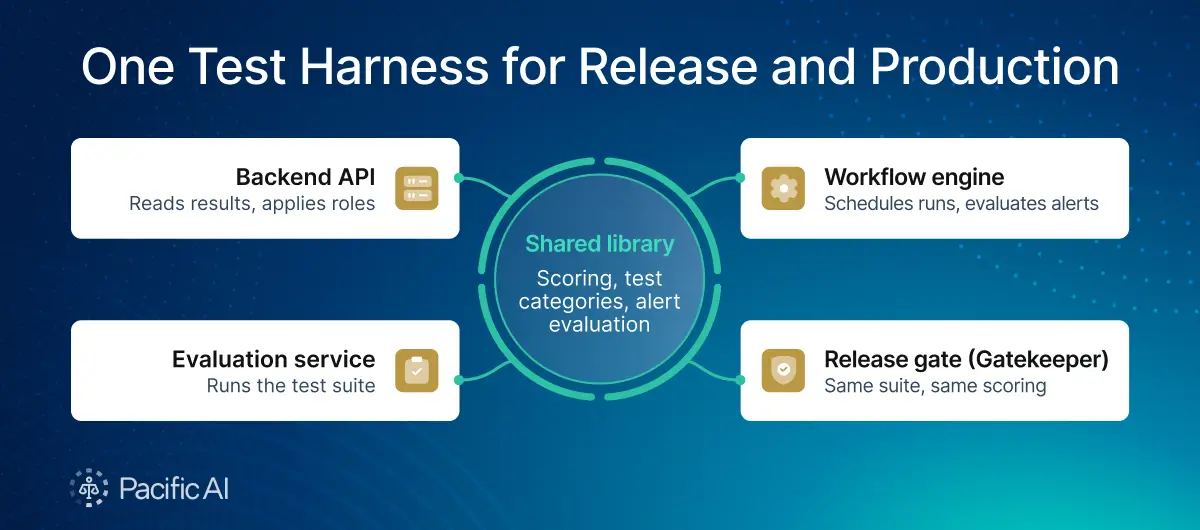
Sharing one evaluation library across release and production introduces one trade-off: a change in the shared library affects both phases at once. To prevent the baseline from moving when old results change, Pacific AI never stores a production baseline as a pointer to a past test run. When a reviewer approves a Gatekeeper run for release, the platform saves the immutable numerical scores as the baseline so Guardian measures drift against fixed numbers.
Deploying inside your private cloud in 10 minutes
Four design choices make continuous AI governance affordable at enterprise scale:
- patching only what changed;
- copying human decisions forward;
- reusing release test suites in production;
- keeping all governance probes and findings inside your network.
You deploy the complete Pacific AI platform (Governor, Gatekeeper, and Guardian) inside your own single-tenant AWS account via AWS CloudFormation or Azure subscription via Azure Managed Apps in 10 minutes. All production probes, workflow engines, LLM gateways, evaluation scores, drift alerts, and risk databases stay inside your virtual private cloud (VPC). Sending clinical prompts or vulnerability findings outside your network creates exposure under HIPAA and GDPR (Regulation (EU) 2016/679); with Pacific AI, we have no access to your data, and you can pair the workflow engine with a local LLM hosted in your private tenant or run in a supported airgap deployment.
The platform is also MCP-native via the Model Context Protocol, enabling your team to plug agentic AI systems into Pacific AI’s governance layer without custom connectors. Install Pacific AI from the AWS or Azure Marketplace or request a technical demo to automate continuous governance across your AI portfolio.
Frequently Asked Questions
What triggers an automated risk reassessment in Pacific AI Governor?
Governor triggers an automated reassessment when two events occur: an engineer updates system documentation (such as an architecture specification, data flow diagram, or repository commit) or a compliance leader updates an organizational policy. System document updates queue a reassessment for that specific AI system, while quarterly updates from the AI Policy Suite queue reassessments across all deployed AI systems governed by the updated policy.
Does automated risk reassessment overwrite previous human compliance decisions?
No. Deterministic platform code locks the titles, descriptions, and mitigation controls of all previously approved risks so the LLM cannot alter them. Previously rejected risks are excluded from the LLM prompt and copied forward as rejected, while newly discovered risks are flagged as drafts for human sign-off.
Why must production drift baselines save numerical scores instead of pointing to a past test run?
Gatekeeper and Guardian share a single evaluation library so pre-release and post-deployment scores remain comparable. Because a change in the shared library affects both phases, a baseline stored only as a pointer to a past run would move if old results changed. Saving the numerical scores at release time ensures Guardian measures production drift against a fixed reference.
Does any clinical data or system documentation leave our network during continuous monitoring?
No. Pacific AI deploys as a single-tenant application inside your own AWS VPC or Azure subscription in 10 minutes, with full support for airgap deployment and local LLMs hosted in your private tenant. All production probes, evaluation scores, and risk version histories remain inside your network with zero external data access by Pacific AI.